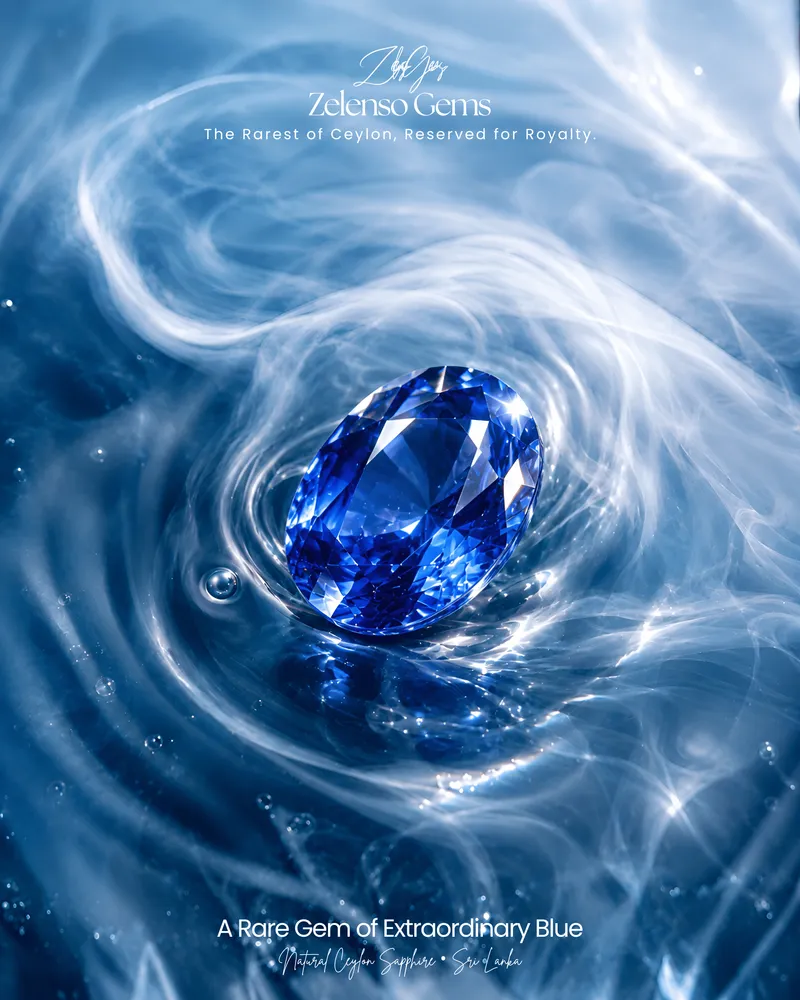
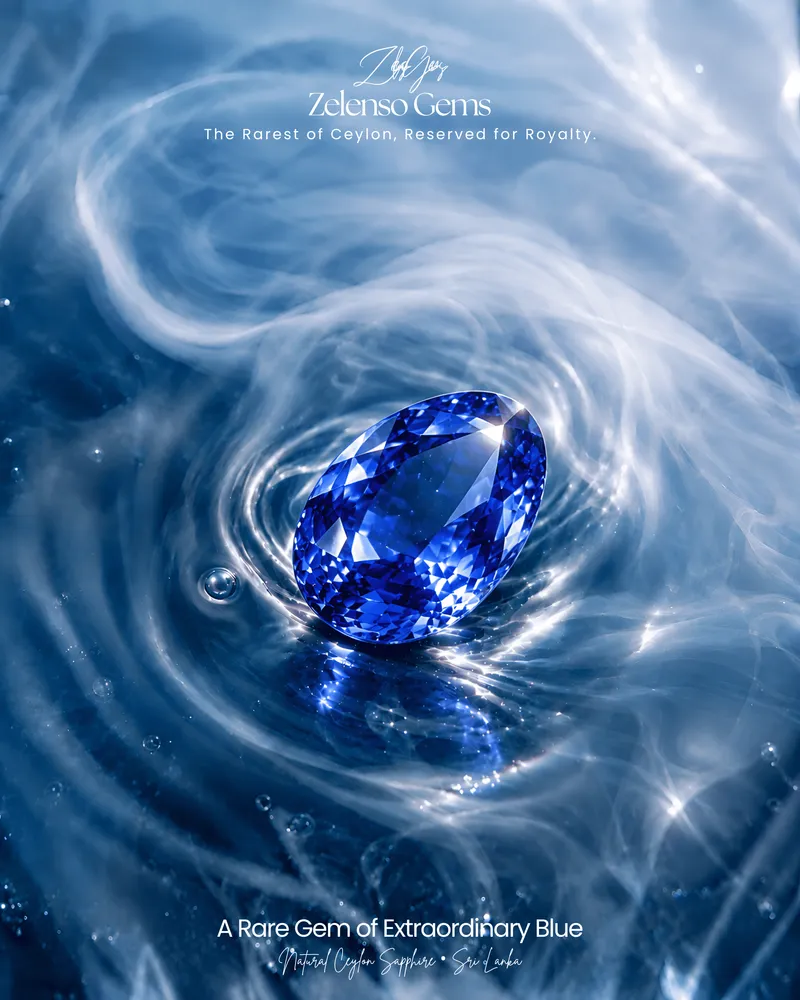
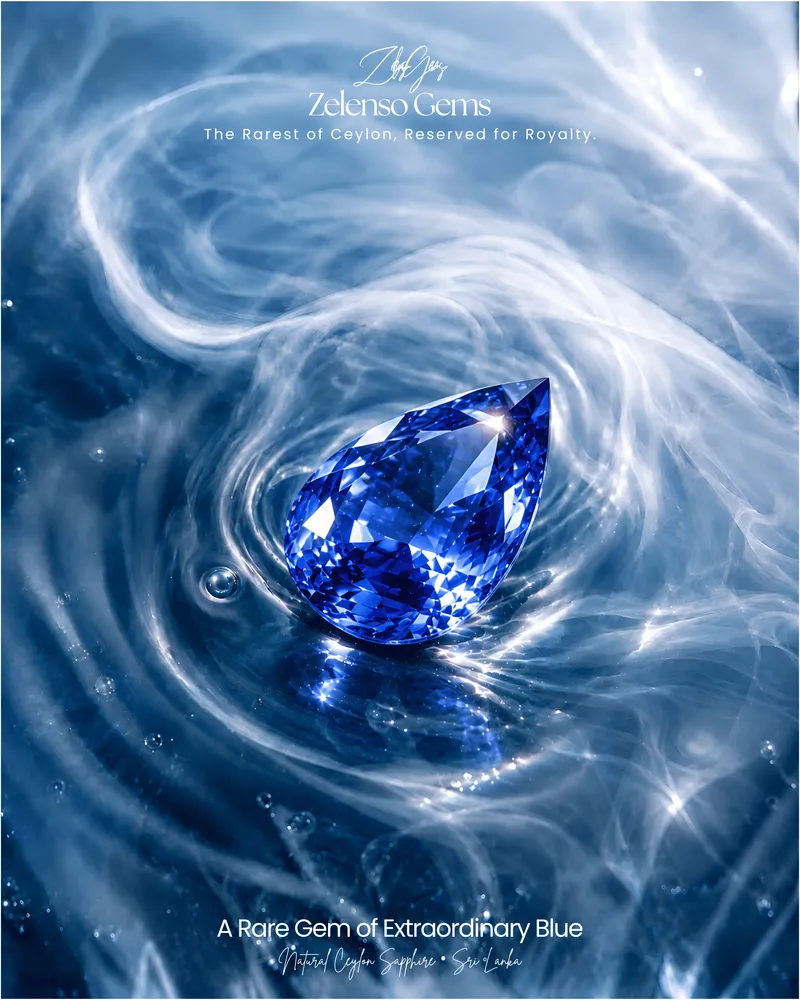
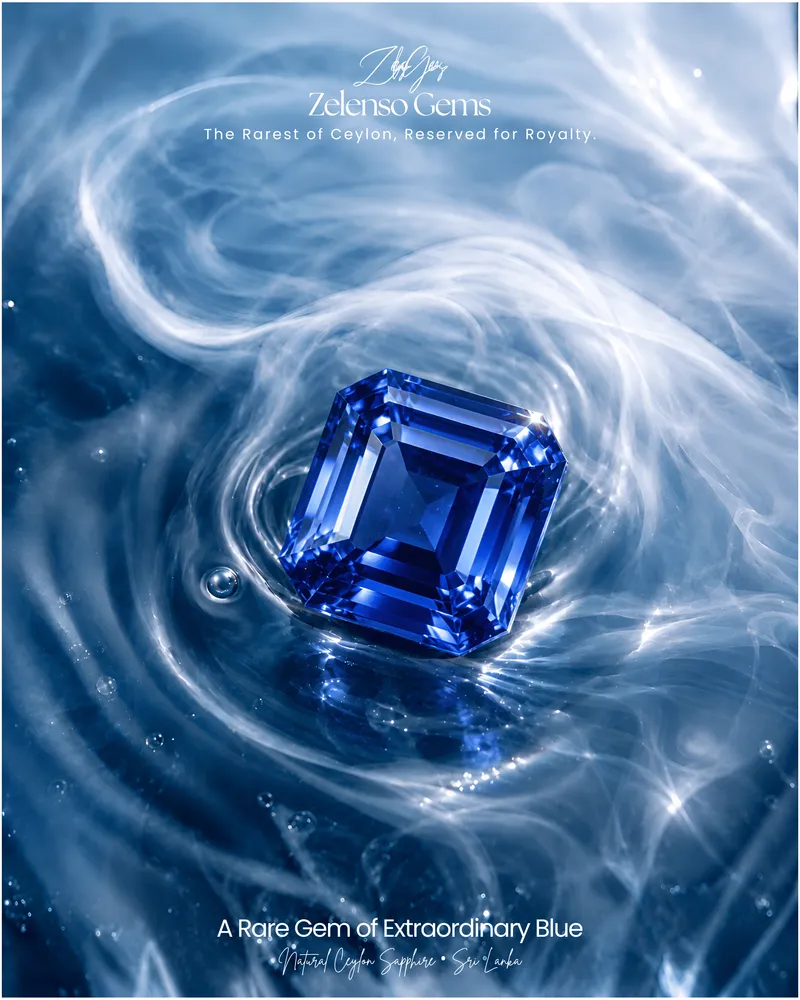
What Is Ceylon Blue Sapphire?
AEO Direct Answer: A Ceylon Blue Sapphire is a natural precious gemstone composed of aluminium oxide (Al₂O₃) from the corundum mineral family, mined specifically on the Indian Ocean island of Sri Lanka. Known historically as Ceylon, Sri Lanka produces blue sapphires famed for their vibrant light transmission, open blue saturation, and remarkable hardness (Mohs 9), making them one of the world's most coveted jewellery and collector stones.
In mineralogical science, pure corundum is chemically colourless. The magnificent blue coloration of a Ceylon sapphire is caused by trace element substitution in the crystal lattice. When minute quantities of iron (Fe²⁺) and titanium (Ti⁴⁺) substitute for aluminium atoms, an atomic phenomenon known as intervalence charge transfer occurs. Light passing through the crystal absorbs red and yellow wavelengths, reflecting back the luminous blue spectrum that has captivated humankind for millennia.
The name "Ceylon" originates from the historic European trade name for Sri Lanka. While the nation officially became the Republic of Sri Lanka in 1972, global auction houses (such as Christie's and Sotheby's), major gemological laboratories (such as the GIA, Gübelin, and SSEF), and luxury Parisian and London high jewellery houses continue to use "Ceylon Sapphire" as the definitive origin pedigree designation.
Why Is Ceylon Blue Sapphire Famous?
AEO Direct Answer: Ceylon Blue Sapphire is globally famous because Sri Lanka possesses the world's longest continuous, uninterrupted history of sapphire mining—spanning over 2,500 years. Ceylon sapphires have adorned the crowns of European, Persian, and Asian monarchs, set world auction records, and famously served as the royal engagement ring worn by Diana, Princess of Wales, and Catherine, Princess of Wales.
Ancient Sanskrit texts referred to Sri Lanka as Ratna Dweepa, meaning the "Island of Gems." Arab traders traversing the ancient Indian Ocean maritime Silk Route named the island Serendib, from which the English word "serendipity" was coined—inspired by the unexpected treasures discovered in its river gravels. King Solomon of Judea reportedly sent emissaries to the island to procure precious blue gems to court the Queen of Sheba. Marco Polo, visiting in 1292, wrote that Ceylon produced the finest sapphires, rubies, and topazes anywhere on earth.
Famous Historic Ceylon Sapphires in Global Collections
- The Star of India (563.35 carats): One of the world's largest gem-quality star sapphires, discovered in Sri Lanka and housed at the American Museum of Natural History in New York.
- The Logan Sapphire (422.99 carats): A flawless, cushion-cut natural unheated Ceylon sapphire set with diamonds, exhibited at the Smithsonian National Museum of Natural History in Washington, D.C.
- The British Imperial State Crown: Both St. Edward's Sapphire (dating back to Edward the Confessor in 1042) and the Stuart Sapphire are historic Ceylon stones set into the United Kingdom's sovereign regalia.
- The British Royal Engagement Ring: The 12-carat oval Ceylon Blue Sapphire engagement ring selected by Lady Diana Spencer in 1981, now worn by the Princess of Wales.
The Colour of Ceylon Blue Sapphire: The Science & The Eye
AEO Direct Answer: The colour of a Ceylon Blue Sapphire is evaluated using three scientific criteria: Hue (the primary blue colour and secondary violetish undertones), Tone (the lightness or darkness, with 60%–75% medium-dark being ideal), and Saturation (the intensity and purity of the colour). Ceylon sapphires are celebrated for their open, luminous cornflower and royal blue hues that maintain brilliance without turning black in evening lighting.
Unlike sapphires formed in iron-rich basaltic volcanic rocks (such as those from Australia, Thailand, or Nigeria), which frequently suffer from excessive dark extinction and appear black or inky in low light, Sri Lankan corundum formed in metamorphic metamorphic granulite terrains. This lower iron concentration creates an "open" crystal structure that permits high light throughput, producing the vibrant, lively sparkle characteristic of fine Ceylon gems.
Cornflower Blue (Kornblumenblau)
A bright, vivid medium blue reminiscent of the wild cornflower petal (Centaurea cyanus). It exhibits a soft, luminous radiance, often with a whisper of violet. Highly prized in European and American jewellery connoisseurship.
Royal Blue
A deep, richly saturated, intense medium-dark blue. When unheated and possessing pure vivid saturation without greyness, fine Ceylon Royal Blue stones represent the pinnacle of global auction values.
Gemologist Caution Regarding Marketing Names
Terms like "Royal Blue" or "Cornflower Blue" are descriptive trade designations, not universal grading laws. While high-end laboratories like Lotus Gemology, GRS, and Gübelin have strict master-stone criteria for issuing these colour comments, disreputable vendors often apply "Royal Blue" stickers to dark, opaque stones. Always judge the visual balance of lightness and saturation with your own eyes and verify with an independent laboratory report.
What Makes a Ceylon Blue Sapphire Valuable? (The 8-Factor Matrix)
AEO Direct Answer: The value of a Ceylon Blue Sapphire is governed by the interaction of eight interdependent factors: Colour (accounting for up to 50–60% of value), Treatment status (unheated vs heated), Carat weight, Clarity & Transparency, Cut & Proportions, Independent Laboratory Certification, Documented Geographic Origin, and Overall Visual Life (scintillation and fire).
Unlike diamonds, which are graded by rigid mechanical formulas, coloured gemstone valuation is nuanced. A single negative trait—such as a deep window or heavy grey overtone—can discount a stone significantly, while natural unheated status and exceptional saturation can compound value exponentially.
| Value Driver | Lower Valuation Characteristics | Premium / Investment Characteristics |
|---|---|---|
| 1. Colour | Overly pale, inky black, brownish/greyish overtone | Vivid Cornflower or Royal Blue with pure saturation |
| 2. Treatment | Beryllium diffused, lead-glass fracture filled | Completely Unheated (Natural, No Heat) |
| 3. Clarity | Heavy eye-visible fractures, opaque clouds, cracks | Eye-clean with high crystalline transparency |
| 4. Cut & Light | Deep "windowing" (see-through belly), asymmetric | Custom precision cut with total internal reflection |
| 5. Carat Weight | Abundant small commercial sizes (<1.00 ct) | Rare large fine rough (3.00 ct, 5.00 ct, 10.00+ ct) |
| 6. Origin Proof | Undocumented, ambiguous or basaltic origin | Documented Sri Lankan (Ceylon) provenance |
| 7. Certification | No report or unaccredited verbal dealer claim | GIA, SSEF, Gübelin, Lotus, or NGJA report |
| 8. Scintillation | Extinct, dull, lifeless center when tilted | Dynamic play-of-light across all lighting environments |
How Much Is Ceylon Blue Sapphire Worth? (2026 Valuation Framework)
AEO Direct Answer: There is no single universal price per carat for Ceylon Blue Sapphire. In the 2026 global gemstone market, prices range from $350 per carat for commercial heated stones to upwards of $40,000 to $60,000+ per carat for rare, unheated 5-to-10 carat collector gems. Price per carat scales non-linearly with carat weight and quality tier.
A common misconception among first-time buyers is that a 4-carat sapphire is worth four times as much as a 1-carat sapphire. In reality, geological rarity dictates that as carat weight increases, the price per carat compounds. A 5-carat top-grade unheated Ceylon sapphire can command 15 to 25 times more per carat than a 1-carat stone of identical color and clarity.
2026 Indicative Market Price Framework (USD Per Carat)
| Quality Tier | Characteristics | 1.00 – 2.00 ct (Heated) | 2.00 – 4.00 ct (Heated) | 1.00 – 3.00 ct (Unheated) | 3.00 – 5.00+ ct (Unheated) |
|---|---|---|---|---|---|
| Commercial | Pale or inky, moderate windowing or inclusions | $300 – $650 | $600 – $1,200 | $1,000 – $2,200 | $2,200 – $4,500 |
| Good / Fine | Pleasing medium blue, eye-clean, good cutting | $800 – $1,800 | $1,800 – $3,500 | $3,000 – $6,500 | $6,500 – $14,000 |
| Extra Fine | Vivid Cornflower/Royal Blue, high life, excellent cut | $2,000 – $4,000 | $4,000 – $8,000 | $7,500 – $16,000 | $16,000 – $32,000 |
| Exceptional Collector | Connoisseur royal/cornflower, flawless eye clarity, GIA/SSEF | $4,500 – $7,500 | $8,000 – $15,000 | $18,000 – $30,000+ | $35,000 – $60,000+ |
*Research context: October 2026 international retail and bespoke dealership benchmark observations. Figures are indicative guidelines for loose certified stones and vary based on specific lab documentation (GIA/Gübelin/SSEF), currency exchange, dealer margins, and individual crystal beauty.
How Certification Protects the Buyer
AEO Direct Answer: Independent gemological laboratory certification protects buyers by providing unbiased scientific verification of three critical factors: Species Identification (natural corundum vs synthetic), Treatment Disclosure (unheated vs heated vs diffused), and Geographic Origin Opinion (confirming Sri Lankan / Ceylon provenance).
It is vital to understand that coloured gemstone reports do not "grade" sapphires the way diamond certificates grade diamonds. There is no universally standardized "VVS1" or "D-colour" grade for coloured gems. Instead, a laboratory report is a factual identification and authentication document.
World-Leading International Labs
- GIA (Gemological Institute of America) — The premier global standard.
- SSEF (Swiss Gemmological Institute) — Highly respected in international auction houses.
- Gübelin Gem Lab (Lucerne, Switzerland) — Legendary origin and colored stone pioneer.
- Lotus Gemology (Bangkok) — World authorities on corundum and origin research.
Sri Lanka Government Authority
- NGJA (National Gem and Jewellery Authority of Sri Lanka) — The state statutory body operating high-tech laboratories in Colombo and Ratnapura. Every stone exported commercially through official channels passes through the NGJA.
How to Identify a Genuine Ceylon Blue Sapphire
AEO Direct Answer: To identify a genuine Ceylon Blue Sapphire, one must distinguish it from synthetics (lab-grown corundum), simulants (spinel, tanzanite, blue topaz, glass), and deceptive treatments (beryllium lattice diffusion and lead-glass filling). Microscopic inclusion analysis, refractive index testing (1.762–1.770), and independent laboratory testing are the only foolproof methods.
Modern synthetic sapphires created by the Verneuil flame-fusion or hydrothermal processes possess the exact same chemical and physical properties as natural corundum. However, under magnification, a gemologist observes curved striae (growth lines) and gas bubbles in flame-fusion stones, compared to straight, angular growth bands, silk, and mineral inclusions in natural Sri Lankan earth-mined gems.
Dangerous Treatments: Beryllium Diffusion & Lead Glass
In beryllium lattice diffusion, light or near-colourless sapphire is heated with beryllium at extreme temperatures, forcing foreign atoms into the crystal lattice to artificially create vivid blue or yellow colour. In glass fracture filling, poor-quality fractured corundum is treated with lead-glass to mimic high clarity. Both treatments drastically lower the value of a stone. Legitimate dealers will always disclose these treatments, and independent lab reports will explicitly state them.
Ceylon Sapphire vs. Kashmir Sapphire vs. Burmese Sapphire
AEO Direct Answer: Ceylon, Kashmir, and Burmese sapphires represent the historic "Big Three" origins of fine blue corundum. Ceylon sapphires are renowned for open, luminous cornflower-to-royal blue brilliance and active artisanal availability; Kashmir sapphires for a sleepy, velvety cornflower hue from virtually extinct high-altitude mines; and Burmese sapphires for deeply saturated, rich royal blue colour.
| Origin | Visual Character | Rarity & Availability | Market Price Benchmark |
|---|---|---|---|
| Ceylon (Sri Lanka) | Luminous, open cornflower and royal blue with high fire and clarity. Never appears black at night. | Sustainable artisanal alluvial mining; continuous supply of world-class rough. | $3,000 – $40,000+ / ct (Unheated, size dependent) |
| Kashmir (India) | Velvety "cornflower" with a soft, dreamy internal glow caused by minute submicroscopic silk. | Practically exhausted. Mined primarily between 1881–1887. Available almost exclusively at auction. | $50,000 – $250,000+ / ct (Auction record level) |
| Burma (Myanmar) | Intensely saturated, rich, deep royal blue with strong natural clarity and minimal color zoning. | Mogok stone tract deposits are highly restricted and depleted; significant geopolitical friction. | $15,000 – $80,000+ / ct (Unheated, size dependent) |
Other Celebrated Sri Lankan Gemstones: Padparadscha & Star Sapphire
AEO Direct Answer: While Ceylon Blue Sapphire is the crown jewel of Sri Lanka, the island produces over 70 of the world's approximately 200 recognized gemstone varieties. Most famous among them are the sacred sunset-coloured Padparadscha Sapphire, asteriated Star Sapphire, yellow sapphire, pink sapphire, chrysoberyl alexandrite, and chrysoberyl cat's eye.
Padparadscha Sapphire: The Sacred Lotus of Ceylon
Named from the ancient Sinhalese word padmaraga (and Sanskrit padma raga), meaning the colour of the lotus flower, this legendary corundum exhibits an ethereal simultaneous harmony of pink and orange—resembling a tropical sunset reflecting across a placid Ceylon lake.
True natural unheated Padparadscha from Sri Lanka is one of the rarest gemstones in existence. Because of its immense value, buyers must exercise extreme caution: synthetic lattice-diffusion with beryllium has been widely used to induce padparadscha colour into worthless pale corundum. A GIA, SSEF, or Gübelin certificate is non-negotiable for Padparadscha acquisition.
Star Sapphire: Celestial Asterism
Star sapphires display the breathtaking optical phenomenon of asterism. When natural microscopic rutile silk needles crystallize in three sets of parallel planes intersecting at 60 and 120-degree angles, light reflects off the needle network into a sharp, six-rayed star when cut as a smooth, rounded cabochon.
In fine Sri Lankan star sapphires, the star is crisp, complete, sharply defined, and centered perfectly on the dome, moving gracefully across the stone as the light source tilts.
Where Ceylon Sapphire Comes From & The Story of Ratnapura
AEO Direct Answer: Ceylon sapphires originate from ancient alluvial gravel deposits known locally as Illam, situated primarily in the Sabaragamuwa province around Ratnapura ("The City of Gems"), Pelmadulla, and Balangoda, as well as Elahera in the central highlands. Sri Lanka's gemstone deposits were formed over 550 million years ago during high-grade metamorphic tectonic collisions.
Centuries of erosion washed the sapphire crystals down from the highland mountain peaks into alluvial riverbeds and floodplains. Today, Sri Lankan gem mining remains uniquely artisanal and environmentally sustainable. Large open-pit commercial strip mining is strictly prohibited by law.
Ratnapura: The Living Gem Capital
Nestled in the lush shadow of Sri Pada (Adam's Peak), Ratnapura is the pulsing heartbeat of the island's gemstone trade. Here, miners excavate vertical shafts (*pathal*) supported by native timber shoring (*kattapani*), drawing up bucket loads of ancient gravel to wash by hand in conical bamboo baskets (*vattiya*).
Each morning, the streets around Ratnapura's Clock Tower transform into an electric open-air market where miners, brokers, and master dealers gather on street corners, trading rough and faceted stones under the soft, natural morning sunlight.
From Rough Stone to Polished Jewel: The Lapidary Art
AEO Direct Answer: Sapphire cutting requires immense gemological skill because corundum is dichroic—displaying different shades of blue depending on the viewing axis. A master cutter must orient the crystal's c-axis perpendicular to the table facet to display the richest blue, while balancing face-up brilliance against weight retention.
Windowing vs. Total Internal Reflection
A shallow cut creates a "window"—a dead zone in the center where light leaks out the back, making the stone appear washed out. A precision cut reflects light back to the viewer's eye with scintillating brilliance.
Extinction vs. Lively Scintillation
Cutting too deep to save carat weight creates "extinction"—black, lifeless areas where light cannot escape. True luxury cutting values beauty and brilliance over dead weight.
Fine Jewellery Design & Investment Realities
AEO Direct Answer: Ceylon Blue Sapphire is the ultimate choice for heirloom engagement rings, pendants, and high jewellery because of its 9 Mohs durability and timeless royal association. While top-grade unheated sapphires have historically preserved wealth and outpaced inflation, gemstones should be acquired as passion assets and personal heirlooms rather than liquid speculative investments.
An Honest Perspective on Gemstone Investment
At Zelenso, we believe in complete financial transparency. Gemstones do not produce dividends or interest. Resale liquidity requires finding a willing collector, auction house, or dealer, where wholesale-to-retail bid-ask spreads exist. Fine unheated Ceylon sapphires are an extraordinary store of portable private wealth, but they should be acquired primarily for love, aesthetics, and generational heritage.
Buyer Checklist & 10 Common Buying Mistakes
✓12 Essential Questions to Ask Before Buying
- Is this gemstone natural, earth-mined corundum?
- What is the precise carat weight and calibrated millimeter dimensions?
- Has this sapphire been heat-treated, or is it completely unheated?
- Has this stone been subjected to beryllium diffusion or fracture filling?
- Is there an independent laboratory report from a recognized institution (GIA, SSEF, Lotus, Gübelin, or NGJA)?
- Does the laboratory report confirm Sri Lankan (Ceylon) geographic origin?
- What is the return policy and independent inspection period?
- Was the photograph or video taken under daylight-equivalent lighting (5500K–6500K)?
- Does the stone exhibit windowing (light leakage) or excessive extinction?
- Is the sapphire eye-clean, or are there internal inclusions that threaten structural durability?
- Is the stone offered loose or mounted? (Mounted stones can conceal pavilion flaws or weight cheats).
- What documentation accompanies the transfer of ownership for customs and insurance?
10 Costly Sapphire Buying Mistakes to Avoid
- Buying solely on carat weight: A 3-carat stone with a deep window can look smaller and less brilliant face-up than a well-cut 2.5-carat gem.
- Assuming "unheated" automatically means exceptional: An unheated stone with poor colour and heavy inclusions is worth far less than a fine heated stone with vivid saturation.
- Trusting verbal "Ceylon" claims without lab documentation: Only a reputable laboratory report provides substantiated origin opinion.
- Judging colour under harsh jewellery store spotlighting: Halogen spotlights exaggerate fire; always examine the gem in natural indirect daylight.
- Confusing heat treatment with synthetic lab-grown stones: Heated stones are natural, earth-mined gems; synthetics are factory creations.
- Overlooking windowing: Seeing straight through the middle of a sapphire like a sheet of glass significantly diminishes beauty.
- Falling for "cheap deals": There are no bargain miracles in global gem hubs. Heavily discounted stones almost invariably carry undisclosed treatments or synthetic origins.
- Neglecting return policies: Always ensure a minimum 7-to-14 day independent appraisal inspection window.
- Ignoring setting durability: Setting a fine sapphire in an open, unprotected prong mounting without considering daily wear.
- Buying from untraceable overseas sellers without established domestic representation or local presence.
Experiencing Gemstones at the Source: Private Journeys with Zelenso
The Zelenso Differentiator: Unlike traditional jewellers who only sell finished stones in glass display cases thousands of miles away, Zelenso connects the world directly with the living heritage of Sri Lanka. We bridge luxury inbound travel with private, transparent gemological exploration.
Imagine descending into the misty, emerald-green mountain valleys of Ratnapura accompanied by a private chauffeur-guide. You stand by the edge of an artisanal river pit, watching miners wash the ancient illam gravel. You meet third-generation master gem cutters in Beruwala, feeling the cool weight of rough corundum transformed by centuries-old lapidary wisdom.
Curated Ceylon Gem Heritage & Luxury Holiday
Combine private gemstone atelier discovery with the very finest Sri Lankan hospitality: luxury private villas, tea bungalow retreats in Hatton (Ceylon Tea Trails), private wildlife safaris in Yala, and coastal relaxation in Galle Fort.
Discover Ceylon's Living Gem Heritage
Whether you are seeking an extraordinary natural Ceylon Blue Sapphire or wishing to experience Sri Lanka's historic gem country on a private, bespoke journey, the Zelenso team is here to guide you with complete transparency and local discretion.
Uncompromising authenticity · Independent gemological certification · Private concierge travel
Frequently Asked Questions about Ceylon Blue Sapphire
Direct, fact-checked gemological answers to the most common buyer, collector, and traveller inquiries.
What is Ceylon Blue Sapphire?
Ceylon Blue Sapphire is a natural precious blue gemstone of the corundum mineral species (aluminium oxide, Al₂O₃) originating from Sri Lanka, historically known as Ceylon. Renowned for its lively brilliance, high transparency, and open cornflower to royal blue hues, it is coloured by trace amounts of iron (Fe²⁺) and titanium (Ti⁴⁺) undergoing intervalence charge transfer.
Is Ceylon Sapphire from Sri Lanka?
Yes. 'Ceylon' is the historic British colonial name for Sri Lanka, which gained independence in 1948 and officially adopted the name Sri Lanka in 1972. In international gemology and high jewellery, 'Ceylon Sapphire' remains the universally accepted trade designation for sapphires mined on the island.
Why is Ceylon Sapphire valuable?
Ceylon Blue Sapphire is valuable due to its exceptional natural beauty, high refractive brilliance, historical pedigree spanning over two millennia, and geological rarity. Unlike basalt-derived sapphires that often appear overly dark or inky, fine Sri Lankan sapphires display luminous, open blue tones that retain their vibrant colour even in dim evening light.
How much is a Ceylon Blue Sapphire worth per carat in 2026?
There is no single fixed price for Ceylon Blue Sapphire. In 2026, indicative market prices range from $300 to $1,500 per carat for commercial heated stones; $2,500 to $7,500 per carat for fine heated stones; and $6,000 to $30,000+ per carat for fine, certified unheated stones. Exceptional collector stones over 5 carats with vivid royal blue colour can exceed $40,000 to $60,000+ per carat at auction.
Why does sapphire price per carat increase with size?
Price per carat increases exponentially rather than linearly with gemstone weight. Large, clean corundum crystals are exponentially rarer in nature than smaller stones. A fine 5-carat unheated sapphire may cost ten to twenty times more per carat than an equivalent quality 1-carat stone because mother nature produces millions of small pebbles for every large, clean gem crystal.
Are Ceylon sapphires heated?
Approximately 95% of all gem-quality sapphires on the global market undergo traditional heat treatment. Heating at temperatures between 1,200°C and 1,800°C is an accepted, permanent industry practice that dissolves excess rutile silk and optimizes natural colour. However, natural unheated sapphires that emerge with fine colour from the earth represent fewer than 5% of all stones and command substantial price premiums.
What is an unheated Ceylon Sapphire?
An unheated (or 'no heat') Ceylon sapphire is a stone that has undergone zero thermal alteration after extraction from the ground. Its colour, transparency, and clarity are entirely the work of geological forces over hundreds of millions of years. Its untreated status must be independently confirmed under microscopic and spectroscopic examination by a reputable gemological laboratory.
How can I tell if a Ceylon Sapphire is genuine?
A genuine Ceylon sapphire can only be verified with certainty through professional gemological testing. Reputable independent laboratories like GIA, Lotus Gemology, SSEF, Gübelin, or Sri Lanka's National Gem and Jewellery Authority (NGJA) examine internal inclusion scenes, refractive indices, specific gravity, and trace element chemistry to verify natural corundum origin, detect treatments, and determine geographic origin.
Is Ceylon Sapphire better than Kashmir Sapphire?
Neither is universally superior; they possess distinct visual personalities and historical contexts. Kashmir sapphires, mined briefly in the 1880s from remote Himalayan deposits that are now virtually extinct, are famous for a dreamy, velvety cornflower hue caused by microscopic silk. Ceylon sapphires offer a more lively, scintillating, open brilliance and are actively, sustainably mined today, making them attainable for bespoke jewellery.
Is Ceylon Sapphire better than Burmese (Myanmar) Sapphire?
Burmese sapphires from the Mogok stone tract are renowned for deep, saturated, rich royal blues with high clarity. Ceylon sapphires generally offer a brighter, more luminous, and open cornflower to royal palette. Fine unheated specimens from both origins are highly coveted by collectors and achieve premium results at major auction houses.
What colour is the most valuable Ceylon Sapphire?
The most commercially valuable colour grades are vivid 'Royal Blue' (a rich, deeply saturated medium-dark blue) and 'Cornflower Blue' (a bright, velvety medium blue reminiscent of the cornflower petal). Value drops if the stone is too light (pastel/watery), too dark (inky/black extinction), or possesses significant gray or greenish secondary overtones.
What is a Padparadscha Sapphire?
Padparadscha sapphire is an exceedingly rare variety of corundum exhibiting a delicate blend of pink and orange, historically likened to the colour of a Sri Lankan lotus blossom (*Nelumbo nucifera*) at sunset. True unheated Padparadscha sapphires of Sri Lankan origin are among the rarest and most expensive coloured gemstones in the world.
What is a Star Sapphire?
A Star Sapphire displays the optical phenomenon known as asterism. When cut as a dome-shaped cabochon, microscopic needle-like inclusions of rutile (silk) oriented at 60-degree angles reflect light into a distinct six-rayed star that moves smoothly across the stone's surface under direct illumination. Sri Lanka is historically the premier source of fine star sapphires.
Where is Ceylon Sapphire found in Sri Lanka?
The primary gemstone-bearing deposits are located in the alluvial river gravels (known locally as 'Illam') of the Sabaragamuwa province, centred around Ratnapura ('The City of Gems'), Pelmadulla, Balangoda, Nivithigala, and Kalawana. Significant deposits also exist in Elahera in the Central province and Okkampitiya/Kataragama in the south.
Why is Ratnapura called the City of Gems?
Ratnapura translates directly from Sanskrit and Sinhala as 'City of Gems' (*Ratna* = gem, *Pura* = city). For over two millennia, the valley surrounding Ratnapura beneath sacred Adam's Peak (Sri Pada) has been the epicenter of Sri Lankan gem mining, washing, cutting, and street trading, hosting one of the most vibrant daily open-air rough gem markets in the world.
What other gemstones are found in Sri Lanka?
Sri Lanka is one of the most gem-dense landmasses on Earth. In addition to blue sapphire, the island yields Padparadscha, star sapphire, yellow sapphire, pink sapphire, ruby, chrysoberyl alexandrite (celebrated for its dramatic green-to-red colour change), chrysoberyl cat's eye, spinel, rhodolite and spessartine garnet, tourmaline, zircon, and moonstone.
Does Ceylon Blue Sapphire make a good engagement ring?
Yes. Blue sapphire is the premier coloured gemstone for engagement rings. With a Mohs hardness of 9 and no cleavage planes, it resists scratching and chipping, making it suitable for daily, lifetime wear. The royal heritage established by Princess Diana and the Princess of Wales has cemented Ceylon sapphire as a timeless symbol of devotion.
Is Ceylon Blue Sapphire a good financial investment?
Fine, unheated Ceylon sapphires of exceptional color and size (3+ carats) accompanied by top-tier laboratory certification have historically maintained value and appreciated over long horizons due to geological scarcity. However, gemstones should be viewed primarily as emotional luxury and passion assets rather than liquid financial instruments.
What is 'windowing' in a sapphire cut?
Windowing occurs when the pavilion (bottom facets) of a faceted gemstone is cut too shallow, allowing light to pass directly through the centre rather than reflecting back to the viewer's eye. A windowed stone looks see-through and washed out in the middle when viewed face-up, significantly reducing its brilliance and market value.
Which laboratory report should I insist on when buying a sapphire?
For international luxury purchases, insist on reports from globally recognized independent laboratories: GIA (Gemological Institute of America), SSEF, Gübelin, or Lotus Gemology. For stones acquired in Sri Lanka, official certification from the National Gem and Jewellery Authority (NGJA) is the respected government benchmark.
Can I visit an authentic sapphire mine in Sri Lanka?
Yes. Through curated luxury private travel with Zelenso, visitors can safely visit operational traditional gem mines in Ratnapura, observe the washing of alluvial gravels, meet third-generation master lapidaries, and explore private gemstone collections with complete transparency and local discretion.
How does Zelenso connect gemstone heritage with travel?
Zelenso uniquely integrates luxury inbound travel with private gemological discovery. Our bespoke journeys combine private chauffeur travel, heritage tea plantation retreats, cultural heritage sites, and exclusive access to Sri Lanka's historic gem centres in Ratnapura and Beruwala, creating an authentic journey from mine to jewel.
This publication was researched and written by the Zelenso Editorial Team in Colombo and Ratnapura, Sri Lanka. Gemological facts, mineralogical criteria, and laboratory testing standards were verified against published educational research from the Gemological Institute of America (GIA), the National Gem and Jewellery Authority of Sri Lanka (NGJA), and Lotus Gemology (Bangkok).
Zelenso does not make speculative financial return guarantees. All pricing frameworks represent 2026 international retail and bespoke dealership observations and are provided strictly for educational guidance.