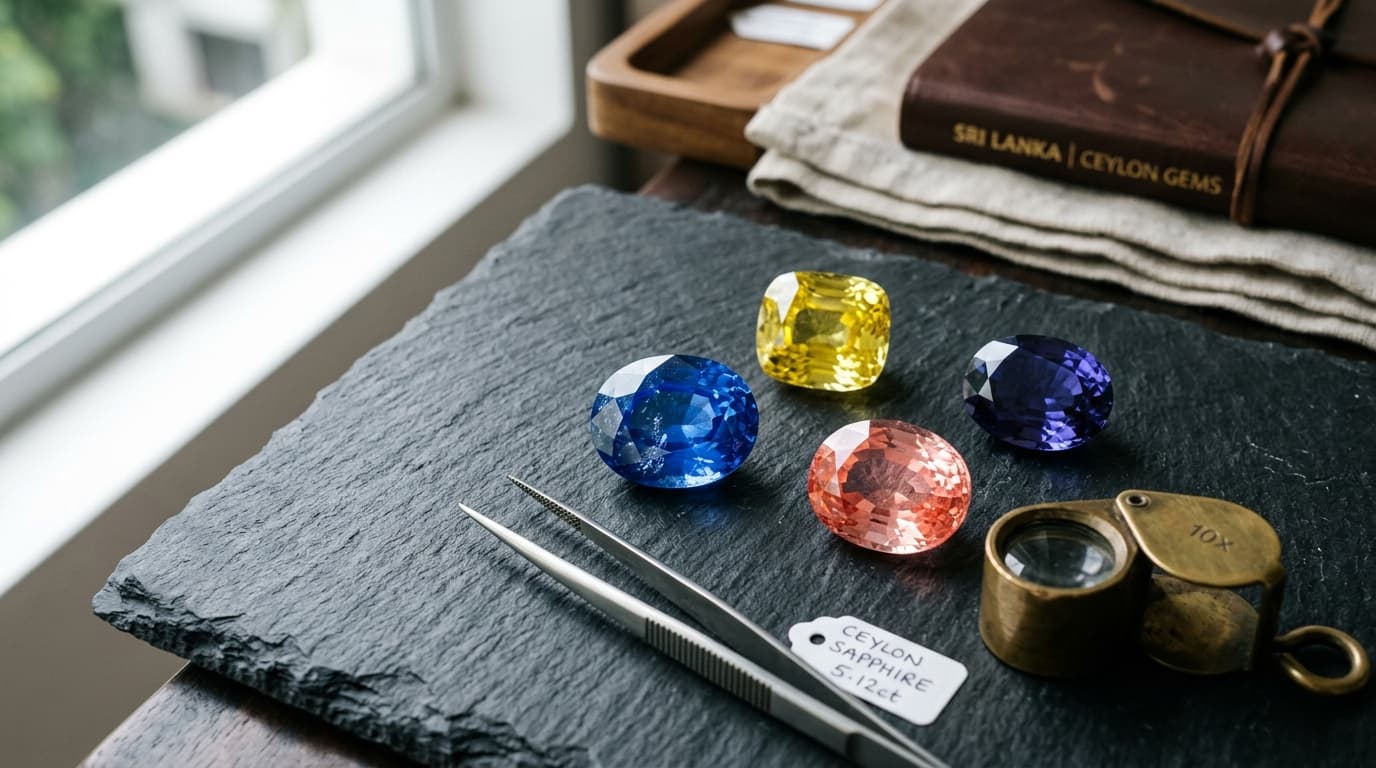
Essential Facts for Travellers & Gem Buyers (At a Glance)
What makes Ceylon sapphires unique?
Ceylon sapphires possess open crystalline clarity and luminous cornflower-to-royal-blue coloration. Coloured by iron and titanium in low-iron metamorphic rock, they avoid the inky darkness found in basaltic sapphires from Australia or Thailand.
Is it safe to buy gemstones in Sri Lanka?
Yes, if buying strictly from dealers licensed by the National Gem and Jewellery Authority (NGJA) and insisting on independent laboratory reports. Never buy from unlicensed street touts or commissions-driven tour stops.
Can tourists legally export gemstones?
Tourists may legally export cut and polished gemstones or finished jewellery accompanied by an official dealer invoice. Exporting rough or uncut gem gravel by tourists is strictly prohibited under Sri Lankan law.
Are all Ceylon sapphires unheated?
No. Approximately 90%–95% of sapphires worldwide undergo standard thermal enhancement (heat). Heated stones are completely acceptable, but unheated natural sapphires are geological rarities commanding 40% to 120%+ value premiums.
Why Sri Lanka Is Famous for Gemstones: The 2,500-Year Legacy of Ratna-Dweepa
Long before it was known to Arab seafaring merchants as Serendib or to British colonial administrators as Ceylon, ancient Sanskrit chronicles christened this teardrop island Ratna-Dweepa—the “Island of Gems.” For more than twenty-five centuries, Sri Lanka has remained the world’s most densely concentrated repository of precious and semi-precious corundum, chrysoberyl, and collector minerals.
Historical records corroborate an extraordinary trading legacy: King Solomon reportedly dispatched envoys to Sri Lanka in the 10th century BCE to secure rubies and sapphires for the Queen of Sheba. The Greek geographer Ptolemy mapped Ceylon’s sapphire-producing rivers in the 2nd century CE. When Marco Polo dropped anchor along the southern coast in 1292, he recorded that the king possessed a ruby “a span long and as thick as a man’s arm, brilliant beyond description.” In modern times, the 12-carat oval Ceylon blue sapphire selected by Lady Diana Spencer for her 1981 engagement ring—now worn by Catherine, Princess of Wales—solidified Ceylon sapphires as the world’s preeminent royal gemstone.
The Geological Miracle: The Precambrian Highland Complex
Why does a small tropical island of only 65,610 square kilometres contain over 70 distinct coloured gemstone varieties? The explanation lies in deep geological time. Approximately 550 to 600 million years ago, during the Pan-African orogeny, Sri Lanka sat at the central collision zone of the Gondwana supercontinent, compressed between Madagascar, Mozambique, and East Antarctica.
Tremendous tectonic pressures and temperatures exceeding 800°C subjected the Precambrian aluminous and silica-deficient sediments of Sri Lanka’s Highland Complex to granulite-facies metamorphism. Aluminium, beryllium, zirconium, and titanium crystallised into corundum, chrysoberyl, spinel, and zircon. Millions of years of tropical rainfall and tectonic uplift eroded these primary metamorphic host rocks, carrying the dense, durable crystals down river valleys into quaternary alluvial gravel beds known locally as illam.
What Is a Ceylon Sapphire? The Science, Optical Brilliance & Origin Distinction
A Ceylon sapphire is a natural corundum gemstone (aluminium oxide, Al₂O₃) originating from the island of Sri Lanka. Corundum is pure colourless mineral crystal in its chemically pristine state (known as white sapphire). The rich spectrum of sapphire colours arises entirely from trace atomic impurities substituting into the crystal lattice during metamorphic formation.
In blue sapphires, trace amounts of iron (Fe²⁺) and titanium (Ti⁴⁺) occupy adjacent aluminium sites. Under ambient light, an electron transfers between the iron and titanium ions—a quantum phenomenon known as intervalence charge transfer (IVCT). This atomic transfer absorbs red, orange, and yellow wavelengths, transmitting pure, vibrant blue light to the human eye.
| Gemological Characteristic | Sri Lanka (Metamorphic Origin) | Australia / Thailand (Basaltic Origin) | Kashmir (Historic Origin) |
|---|---|---|---|
| Host Geology | Metamorphic granulite / pegmatite | Alkali basaltic volcanic flows | Metasomatic pegmatite in marble |
| Iron (Fe) Content | Low to moderate | Extremely high iron concentration | Low iron |
| Color & Transparency | Luminous cornflower, vivid royal blue, open & transparent | Dark inky blue, greenish undertones, extinction | Velvety cornflower with silk haze |
| Current Availability | Continuous active commercial mining | Extensively mined / commercial | Depleted (historical auction only) |
Because Sri Lankan metamorphic deposits contain lower concentrations of iron than volcanic basaltic deposits in Australia, Thailand, or Nigeria, Ceylon sapphires exhibit open crystal structure without dark blackish masks or greenish secondary hues. A Ceylon sapphire retains its electric blue illumination even in dimly lit evening restaurants or indoor settings where basaltic sapphires appear almost black.
The Sri Lankan Gemstone Guide: 12 Precious & Collector Mineral Profiles
While blue sapphire accounts for the majority of international export revenue, Sri Lanka produces an astonishing treasury of coloured corundum, chrysoberyl, and rare collector species. Explore each profile below to understand chemistry, hardness, localities, and vital buyer checks.
The 12 Core Precious & Semi-Precious Gemstones of Sri Lanka
Filter by mineral family below to inspect chemical structures, Mohs hardness, genuine Sri Lankan localities, common commercial treatments, and vital buyer due diligence checkpoints.
Ceylon Blue Sapphire
Nil Keta (නිල් කැට)
Colours & Appearance
Cornflower blue, vivid royal blue, peacock blue, pastel sky blue
Sri Lankan Heritage Significance
The undisputed national gemstone of Sri Lanka. Renowned for its lively, open brilliance without the dark inky undertones typical of basaltic deposits.
⚠️ Common Treatments & Disclosures
Traditional thermal enhancement (heat). High-end unheated stones command 40%–120%+ rarity premiums.
🔍 Buyer Due Diligence Checkpoints
Examine for zoning lines, silk needles (unheated hallmark), and request written independent lab confirmation of heat status.
Padparadscha Sapphire: The Elusive Lotus Blossom Gem of Sri Lanka
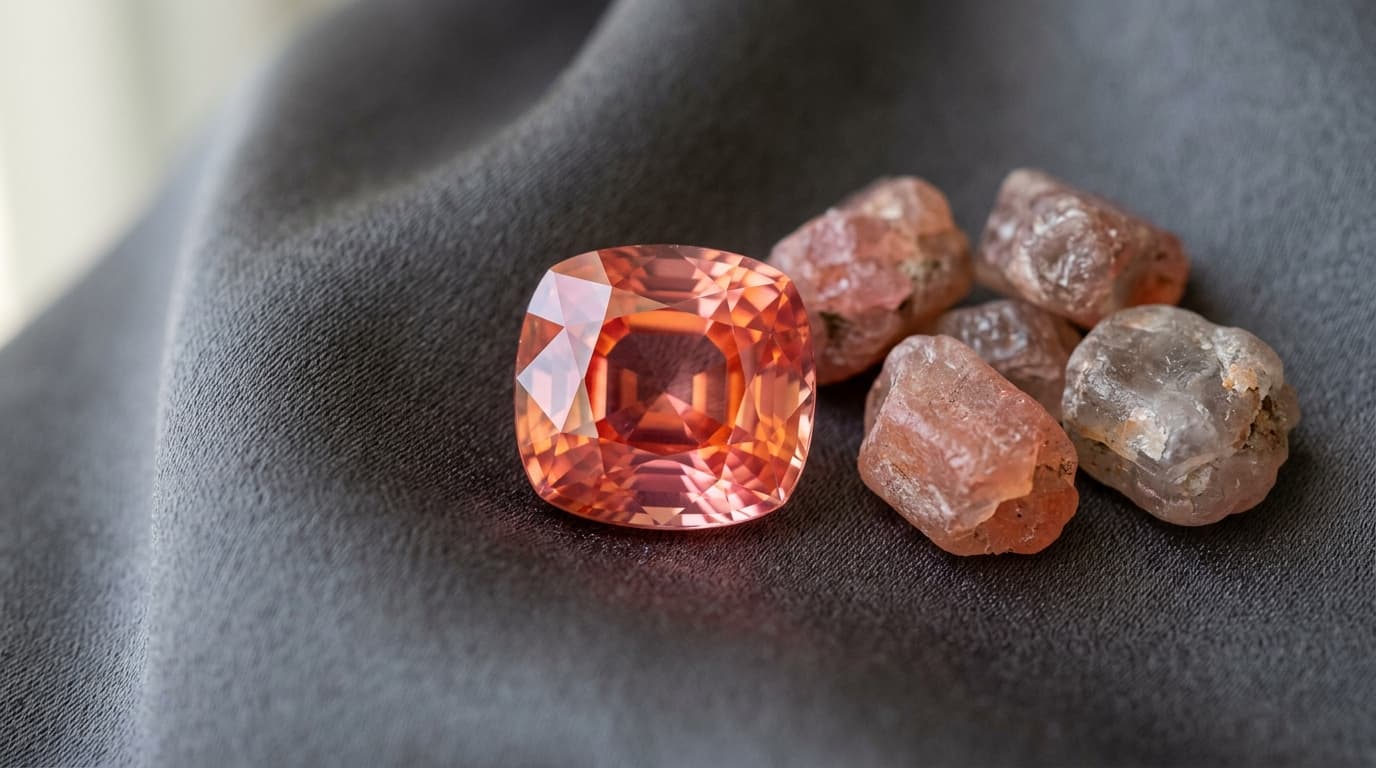 Natural unheated cushion-cut Padparadscha sapphire (pink-orange blend) — Ratnapura alluvial corundum.
Derived from the Sinhalese word Padmaraga (පද්මරාග), which evokes the ethereal blush of the sacred aquatic red lotus blossom (Nelumbo nucifera), the Padparadscha sapphire is universally recognized by international gemologists as the rarest and most romantically evocative variety of corundum in existence.
Strict Gemological Definition: What Qualifies as a True Padparadscha?
International laboratory consensus (including GIA, SSEF, Gübelin, and the Laboratory Manual Harmonisation Committee - LMHC) establishes that a true Padparadscha must possess:
- A delicate, balanced blend of pink and orange with both colours clearly perceptible simultaneously.
- Light to medium tone (overly dark stones with high brownish modifiers are classified as orange sapphire, fancy sapphire, or ruby).
- Color distribution that is relatively homogeneous without dramatic, distracting color zoning.
- Zero evidence of lattice diffusion (such as beryllium treatment) or irradiation.
Because unheated natural Padparadscha sapphires over two carats are extreme geological rarities, fine specimens command between $5,000 and $35,000+ per carat at international auctions. Never purchase a stone labelled “Padparadscha” without an independent certificate from a tier-one gem laboratory that explicitly confirms the color determination in writing.
Where Sri Lanka’s Gemstones Originate: The Island’s 5 Major Gem Fields
Over 90% of Sri Lanka’s land area is composed of Precambrian high-grade metamorphic rocks. However, the commercial extraction of gemstones is concentrated in five primary geological basins where ancient river drainages formed gravel beds:
Ratnapura & The Kalu Ganga Valley
The historic capital of Sri Lankan gemology. Located in the Sabaragamuwa Province, alluvial gravels (illam) lie beneath rice paddies and riverbanks at depths of 3 to 30 metres. Produces the widest spectrum: blue, yellow, and star sapphires, Padparadscha, ruby, alexandrite, and spinels.
Elahera & The Polonnaruwa Basin
Located in the Matale-Polonnaruwa districts, Elahera was discovered in the 1960s and became famous for high-yield mechanized and traditional pits yielding exceptional transparent blue sapphires, tourmalines, and chrysoberyls.
Pelmadulla & Balangoda
Flanking the southern foothills of the central highlands, Pelmadulla is famous for producing large, deeply saturated royal blue sapphires and high-clarity Geuda corundum with ideal crystal structures for thermal enhancement.
Meetiyagoda Moonstone Pegmatites
Located near the southwest coast near Ambalangoda, Meetiyagoda hosts rare kaolinized pegmatite veins yielding the world’s most sought-after orthoclase feldspar moonstones with transparent crystal and electric blue adularescence.
Ratnapura: The Legendary “City of Gems” & Its Living Trading Bourses
Nestled beneath the mist-shrouded peaks of Adam’s Peak (Sri Pada) in southwest Sri Lanka, Ratnapura pulses with the rhythms of a trade that has operated continuously for thousands of years. The town is not an ornamental museum; it is a working commercial exchange where rough crystal pebbles unearthed at dawn change hands on the street corner by mid-morning.
The most atmospheric manifestation of Ratnapura’s gem culture is the daily morning street market along Demuwawatha Street and the Clock Tower square. Beginning around 6:30 AM, hundreds of brokers, miners, and lapidaries gather in small huddles. Rough crystals wrapped in folded white paper (parchement) are opened under natural morning sunlight. Dealers examine stones using portable brass loupes, holding them to the sky to inspect color zoning and crystal fractures.
A Candid Reality Check for Independent Travellers in Ratnapura
Visiting Ratnapura to experience the street bourses and witness mining pits is an extraordinary cultural travel experience. However, the open street market is strictly a professional trading arena for experienced rough buyers.
Brokers communicate values through subtle traditional finger signals beneath towels, evaluate rough stones for optical yield post-cutting, and trade in high-risk unpolished crystals. Independent tourists should never attempt to purchase valuable rough stones on the street without seasoned local gemological guidance and formal laboratory testing facilities.
Traditional Sri Lankan Gem Mining: The Sustainable Craft of Pit Mining & Illam
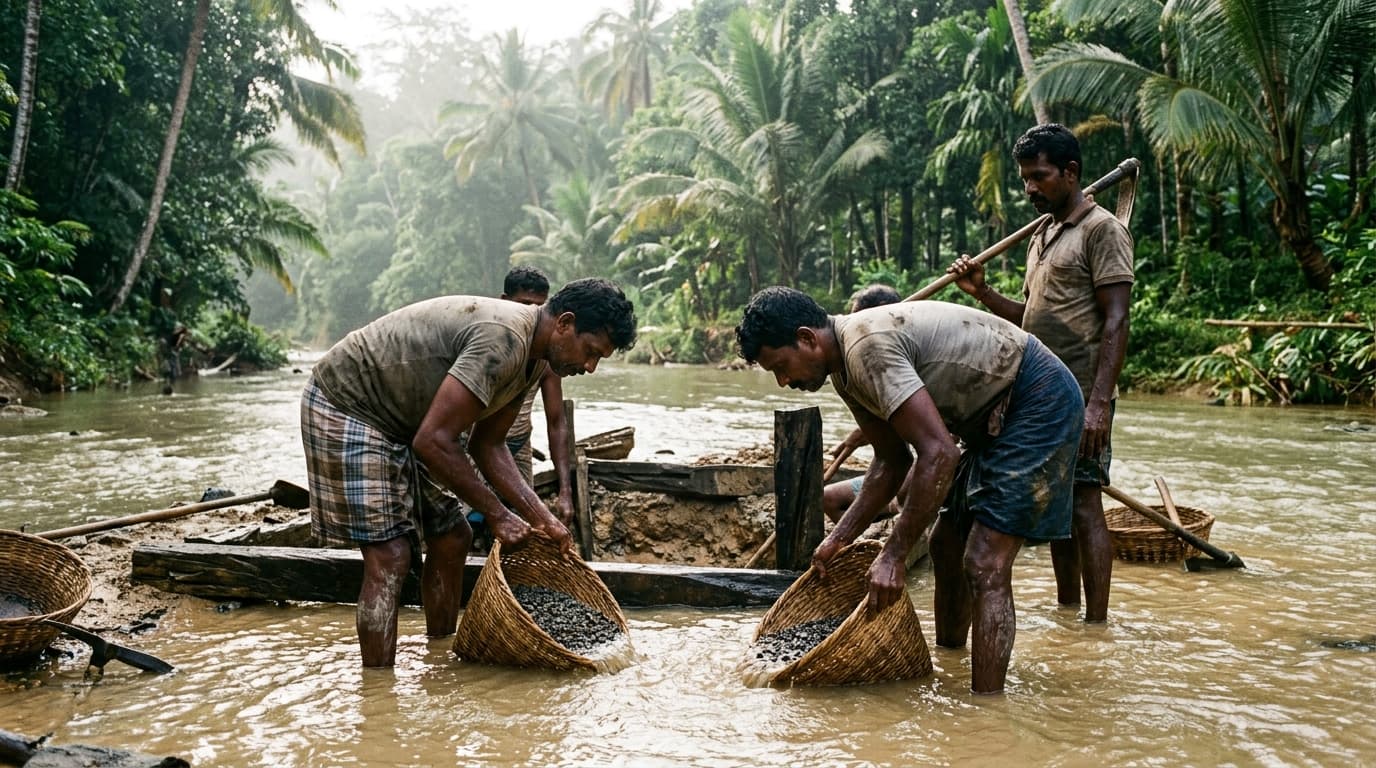 Artisanal pit mining in Ratnapura river gravels — zero mechanized open-cast destruction.
Unlike the massive, environmentally destructive open-cast strip mining witnessed in many diamond and gold fields globally, Sri Lankan gem mining is governed by strict regulations established by the National Gem and Jewellery Authority to preserve ecological topsoil and artisanal livelihoods.
1. Pit Sinking & Shoring (Yathuru Pathala)
Miners sink vertical shafts (typically 2 × 2 metres) through alluvial clay. To prevent cave-ins, the pit walls are reinforced with a wooden framework of wild rubberwood logs and lined with dried fern leaves (kekilla), allowing water to seep through while preventing soil collapse.
2. Extracting the Gem-Bearing Layer (Illam)
Once miners penetrate the non-gem surface clay (depths between 3 and 25 metres), they strike the illam—the dense alluvial quaternary gravel containing rounded quartz pebbles, heavy minerals, and gemstone crystals. The illam is excavated with hand picks and hauled to the surface in woven bamboo buckets.
3. Washing in Conical Baskets (Nambiliya)
The illam is transported to a nearby stream or washing pond. Miners place the gravel inside conical woven cane baskets called nambiliya and submerge them in water, swirling the basket rhythmically. Centrifugal force and gravitational separation wash away light sand and mud, while dense gemstone crystals (specific gravity 3.5 to 4.1) settle into the basket’s point.
4. Sorting & Environmental Reclamation
The basket is tilted toward natural sunlight. Experienced miners swiftly pick through the sorted pebbles with trained fingers, identifying raw sapphire crystals, spinels, and garnets within seconds. Under NGJA licensing conditions, when a pit is exhausted, it must be backfilled and replanted with agricultural crops or tea.
From Rough Stone to Finished Jewel: Lapidary Craftsmanship & Optical Cutting
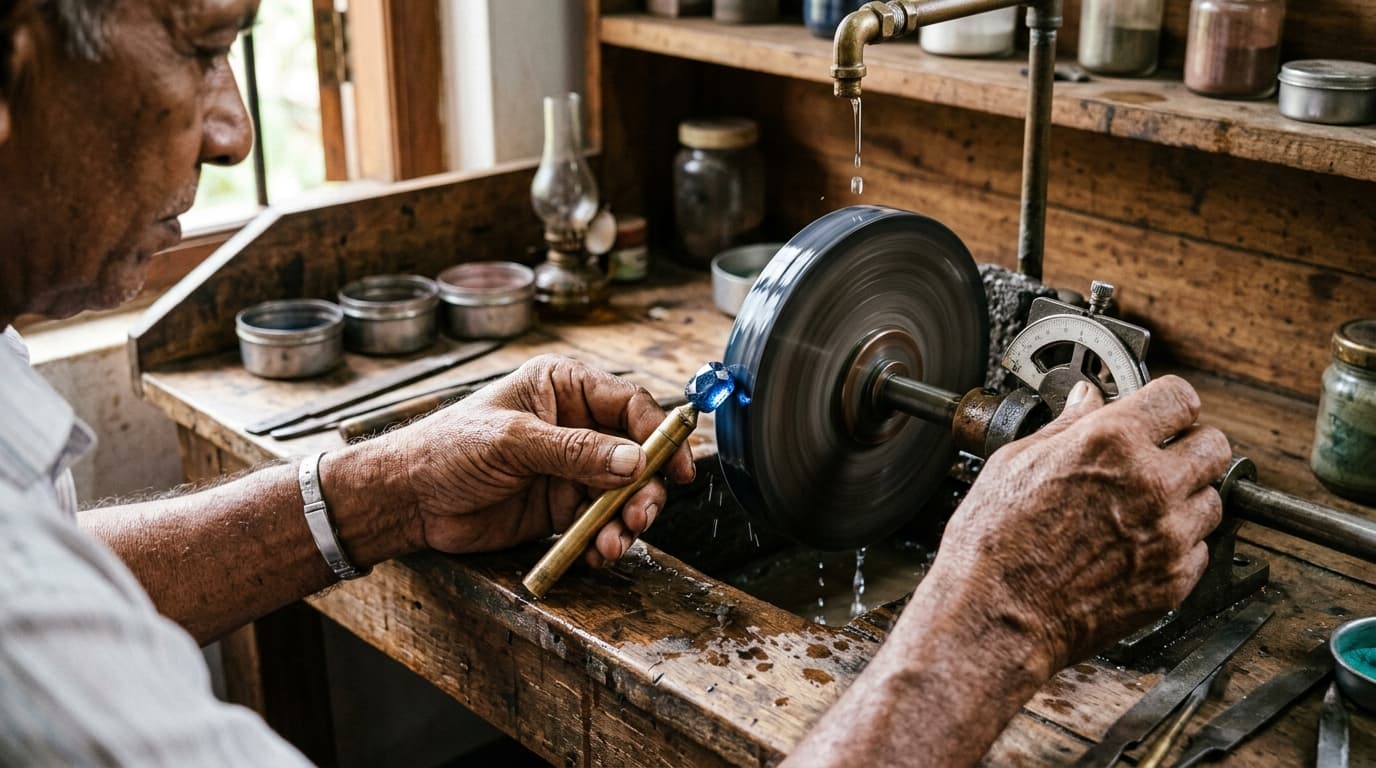 Precision faceting in a Ratnapura gem cutting workshop.
A rough sapphire extracted from river mud looks like an unassuming, frosted pebble. Transforming this rough crystal into a luminous gemstone requires centuries-old lapidary mastery. Sri Lanka has maintained a celebrated cutting tradition since the medieval era, with specialized artisan communities in Ratnapura, Beruwala, and Galle.
The Critical Balance: Weight Retention vs. Optical Brilliance
In coloured gemstone cutting, the cutter faces a fundamental economic and artistic dilemma:
Rough sapphire is sold by carat weight. Traditional local cutters often cut stones with deeper pavilions (bulging bases) to preserve precious carat yield from the rough crystal, but this can cause light to leak through the centre, creating an optical “window.”
Modern master cutters calibrate facet angles specifically to the refractive index of corundum (1.762). Although 10%–20% more weight is sacrificed, light entering the crown reflects internally off pavilion facets, returning 100% of the light to the viewer’s eye with zero windowing or extinction.
How Coloured Gemstones Are Valued: Beyond the Diamond 4Cs
Many consumers attempt to evaluate coloured gemstones using diamond grading logic. This is a fundamental mistake. While diamonds are graded primarily on absence of color and strict mathematical symmetry, coloured gemstones are valued 70% to 80% on the quality and liveliness of their color.
1. Color (Hue, Tone & Saturation)
Hue: The primary color (pure blue, pink, yellow). The finest Ceylon sapphires have pure blue hues with slight violet undertones; greenish modifiers diminish value.
Tone: The lightness or darkness (graded 1 to 10). The ideal tone for Ceylon sapphire is 5 to 6 (medium). Overly dark tones cause inky extinction; overly light tones appear washed out.
Saturation: The intensity and purity of the hue. Vivid and strong saturation command peak market valuations.
2. Crystal Transparency & Clarity (Eye-Clean vs. Loupe-Clean)
In coloured gems, stones are graded with the naked eye from 15 cm, not under a 10x diamond loupe. An “eye-clean” sapphire has no inclusions visible to the unaided eye. Fine silk needles of rutile are actually welcomed by gemologists because they confirm natural origin and scatter light into soft, velvety luminescence.
3. Unheated vs. Heated Rarity Premium
Because nature rarely creates fine corundum with ideal color and clarity without human thermal enhancement, an unheated Ceylon blue sapphire commands a 40% to 120%+ price premium over an identical-looking heated stone of the same carat weight.
4. Exponential Carat Weight Scaling
Gemstone price per carat increases exponentially as weight rises. A top-tier unheated 5-carat Ceylon sapphire is not simply five times the price of a 1-carat stone; it can be 15 to 25 times more expensive per carat due to acute geological scarcity.
Natural, Heated, Treated and Synthetic: What Every Buyer Must Understand
In the international gemstone trade, treatment is not inherently deceptive; undisclosed treatment is fraud. Understanding the spectrum of thermal and chemical treatments protects buyers from paying unheated natural prices for enhanced or lab-grown stones.
Natural Unheated (No Indications of Heating)
Mined from the earth with its natural color and clarity intact. Tested in a laboratory under microscopic immersion to confirm intact rutile silk, sharp negative crystals, and unaltered fluid inclusions.
Full collector & investment value retention.Traditionally Heated (Thermal Enhancement)
Subjected to controlled high temperatures (1200°C–1800°C) without chemical additives. Dissolves minor silk, clarifies haze, and optimizes natural iron-titanium blue saturation. Stable and permanent.
Standard fine jewellery choice; costs 40%–60% less than unheated.Beryllium / Lattice Diffusion
Light elements (beryllium) are forced into the crystal lattice at high temperatures, artificially turning dull corundum into vivid orange or yellow. Color is often shallow and surface-confined.
Worth only a fraction of natural stone value. Must be disclosed!Synthetics & Glass-Filled Stones
Flame-fusion (Verneuil) or hydrothermal lab-grown corundum, or heavily fractured natural ruby/sapphire filled with high-lead glass. Lacks structural integrity and natural rarity.
Low commercial value; tourist trap risk if sold as natural.How to Know if a Gemstone Is Genuine: Debunking Tourist Myths
The internet is littered with viral advice advising tourists to test gemstones using smartphone flashlights, kitchen ice cubes, scratch tests, or breath condensation. As professional gemologists, we state plainly: none of these amateur tricks can reliably identify a genuine natural Ceylon sapphire.
Three Dangerous Tourist Gem Testing Myths to Disregard
- Myth 1: “Scratch test with a coin or knife.” Corundum has a Mohs hardness of 9. A steel knife (hardness 5.5) cannot scratch sapphire, but it also cannot scratch cheap quartz (hardness 7) or synthetic sapphire (hardness 9). Performing scratch tests can chip delicate facet junctions.
- Myth 2: “The smartphone flashlight test.” Looking for bubbles or flashes under phone light cannot differentiate synthetic corundum from natural stones. High-grade flame-fusion synthetics are virtually bubble-free.
- Myth 3: “The breath test.” Synthetic sapphire has the exact same thermal conductivity as natural sapphire, meaning condensation evaporates at the exact same rate.
Legitimate gemological determination relies on calibrated laboratory instrumentation: a refractometer measuring refractive index (1.762–1.770) and birefringence (0.008); a polariscope confirming double refraction; hydrostatic specific gravity balance (3.99–4.01); and high-magnification immersion microscopy revealing diagnostic natural inclusion suites (fingerprint inclusions, silk needles, and unhealed fluid fissures).
Gemstone Certification in Sri Lanka: The National Authority & International Labs
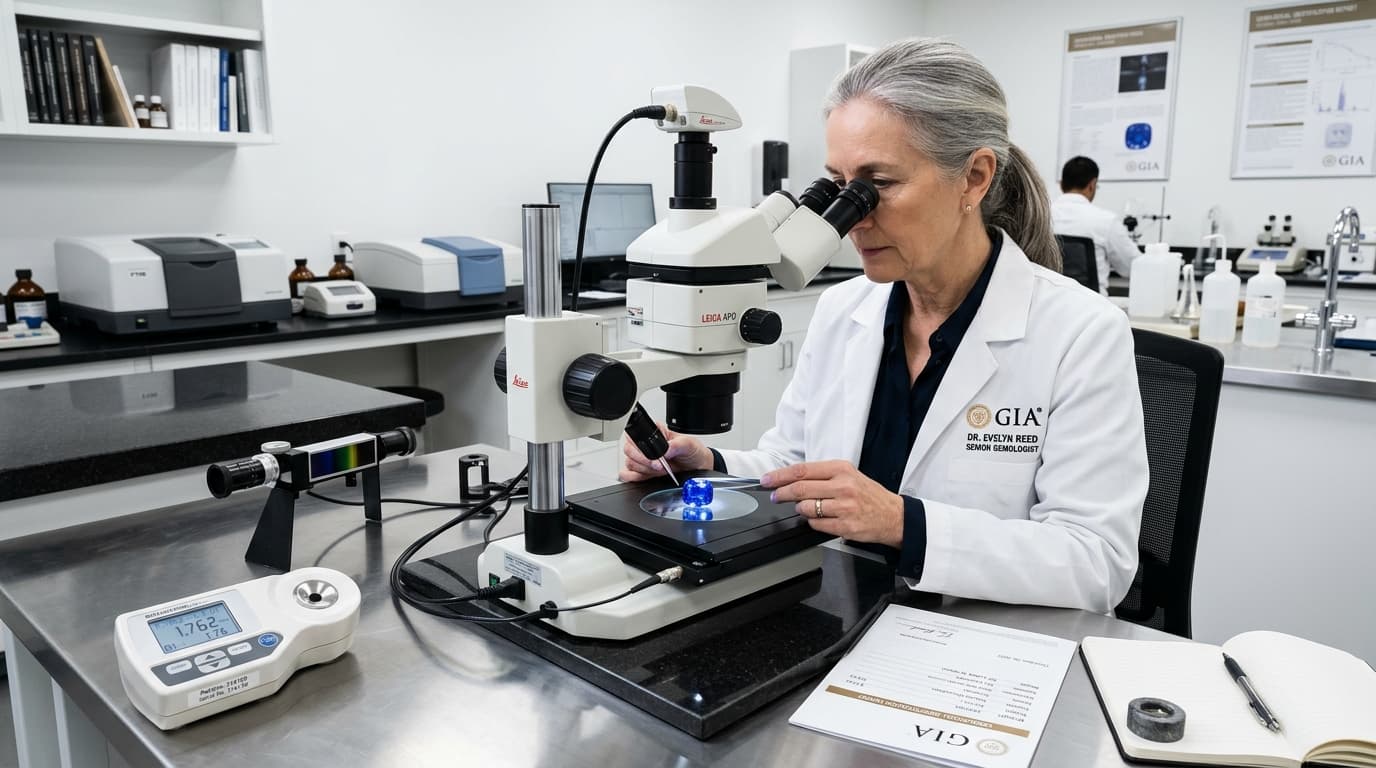 Independent gemological laboratory inspection — spectroscopic analysis & microscopic verification.
The most critical protective barrier between an international buyer and a disappointing purchase is an independent, third-party gemological testing report. A certificate issued by the shop seller themselves is a conflict of interest; only accredited, non-commercial testing laboratories provide genuine protection.
The National Gem and Jewellery Authority (NGJA) Laboratories
Established under Parliamentary Act No. 50 of 1993, the National Gem and Jewellery Authority (NGJA) is Sri Lanka’s official statutory regulatory authority. The NGJA operates state-of-the-art gem testing laboratories staffed by university-qualified gemologists equipped with FTIR spectrometers, EDXRF elemental analyzers, and UV-Vis spectrophotometers.
Affordable and swift (Rs. 1,814 to Rs. 5,140 depending on weight). Establishes mineral species, natural vs. synthetic determination, and confirms thermal enhancement status.
Detailed report (Rs. 5,140 to Rs. 7,559) featuring high-resolution photograph of the stone, exact weight to three decimal places, 3D dimensions, cut proportions, color grade, and official embossed authority seal.
International Independent Laboratory Standards
For high-value investment acquisitions ($5,000 to $50,000+), international collectors and luxury auction houses recognize four premier independent institutions: Gemological Institute of America (GIA), Swiss Gemmological Institute (SSEF), Gübelin Gem Lab (Switzerland), and Lotus Gemology (Bangkok). Top-tier established Colombo dealers maintain inventory with pre-issued reports from these institutions.
How to Buy a Gemstone Safely in Sri Lanka: The 13-Step Buyer Protocol
You do not need to spend twenty years studying crystallography to purchase a beautiful gemstone safely in Sri Lanka. You simply need to execute a disciplined, professional verification protocol:
Define Your Goal & Carat Window
Decide whether you seek a wearable engagement ring sapphire, an unheated investment collector stone, or an affordable travel keepsake before entering stores.
Fix a Firm Total Budget in Clear Currency
Fix your budget in USD, GBP, or EUR. Reputable dealers will show you stones matching your exact financial parameters rather than escalating prices.
Require Written Natural vs. Synthetic Status
Always ask: 'Is this stone 100% natural, earth-mined corundum?' Require that the word 'Natural' is recorded on preliminary quotation papers.
Demand Full Thermal & Chemical Treatment Disclosure
Ask: 'Has this sapphire undergone heating, beryllium diffusion, or fracture filling?' Never accept ambiguous verbal assurances.
Select Only NGJA-Licensed Establishments
Verify the store prominently displays a valid, current National Gem and Jewellery Authority of Sri Lanka dealer license.
Inspect in Natural Daylight (Never Spotlights Alone)
Step near a window or outdoors. Intense halogen showroom lighting makes even mediocre sapphires sparkle; daylight reveals true color tone and transparency.
Examine with a 10x Gemological Loupe
Look for natural crystal growth zoning, silk needles, and ensure there are no deep cracks reaching the crown surface that compromise durability.
Compare Multiple Stones Side by Side
Never look at a single stone in isolation. Place three or four sapphires side by side on a neutral white appraisal card to immediately see color differences.
Request Independent Testing from the NGJA Lab
For any purchase over $500, state that you will complete payment upon receiving an independent test memo from the NGJA laboratory in Colombo or Ratnapura.
Verify Weight & Dimensions with Callipers
Confirm the stone’s weight matches the lab report to two decimal places on an electronic carat scale, and verify dimensions with digital callipers.
Demand a Complete Official Commercial Tax Invoice
Ensure the invoice details company registration, item description, carat weight, price, treatment status, and clear payment receipt.
Review Written Return & Exchange Policies
Clarify whether the dealer offers international return guarantees or exchange provisions if independent evaluation upon returning home differs.
Retain All Documents for Customs Declarations
Keep lab certificates, invoices, and payment receipts together in your cabin baggage for departure customs inspection and arrival declarations.
Tourist Red Flags & Scams: When to Immediately Walk Away
Most international visitors who leave Sri Lanka with negative gemstone experiences made the mistake of ignoring obvious warning signs. Memorize these red flags:
🛑 “Today Only” Dramatic Discounts
If a dealer quotes $6,000 and immediately drops to $1,500 when you hesitate, walk away. Genuine coloured gemstones have real wholesale replacement values. Massive instant markdowns signify wildly inflated initial pricing or low-grade synthetic goods.
🛑 Unsolicited Touts & Free Driver Stops
If an unauthorized taxi driver, tuk-tuk operator, or stranger insists on taking you to a “special government gem factory” or “relative’s mine showroom,” decline immediately. These establishments pay commissions of up to 30% to 50% to drivers, costs added directly to your bill.
🛑 Guaranteed Resale & Investment Promises
If a seller tells you: “Buy this in Sri Lanka for $2,000, and you can easily sell it in London or Frankfurt for $8,000,” this is an outright scam. Retail buyers cannot easily sell loose gemstones at retail prices in Europe without wholesale dealer credentials.
🛑 Refusal of Independent Lab Verification
If a dealer claims: “Our in-house certificate is internationally certified; an NGJA test takes too long and is unnecessary,” decline the purchase. An NGJA test memo takes only 1–2 business days. Reluctance to allow independent testing is the ultimate red flag.
Where Travellers Can Buy in Sri Lanka: Colombo, Ratnapura, Kandy & Galle Fort
Where you choose to buy depends entirely on your travel itinerary, expertise level, and desired purchase experience:
1. Colombo: Best for High-Value, Secure Purchases & Certified Luxury
Colombo is home to Sri Lanka’s most established, multi-generational jewellery houses and international exporters, primarily concentrated in Colombo 03 (Kollupitiya), Colombo 04 (Bambalapitiya), and the high-end arcades of luxury hotels. It offers convenient proximity to the National Gem and Jewellery Authority head testing laboratory, secure credit card transactions, and comprehensive export paperwork.
2. Ratnapura: Best for Cultural Atmosphere & Miner Immersion
Ideal for visiting traditional mines and experiencing the historic gem trade at its source. For cut stone shopping, deal only with established, licensed dealers with permanent showrooms rather than informal brokers on the street. The regional NGJA lab is located directly in town for same-day or next-day testing.
3. Galle Fort: Best for Boutique Designer Jewellery & European Aesthetics
Within the UNESCO World Heritage ramparts of Galle Fort, boutique jewellers cater extensively to European, British, and American travellers. While prices carry a moderate tourist overhead, the settings are contemporary, stylish, and high-quality, with reputable multi-generational dealers offering bespoke mounting in 18k gold or platinum.
4. Kandy & Cultural Triangle: Museum Educational Showrooms
Kandy hosts several large licensed gem museums that offer fascinating lapidary demonstrations and documentary viewings. While educational, prices can be higher due to tourist foot traffic; exercise normal 13-step due diligence before making significant commitments.
Export Laws, NGJA Clearance & Customs: Taking Gemstones Home Legally
Exporting precious gemstones from Sri Lanka is straightforward when adhering to official guidelines established by the National Gem and Jewellery Authority and Sri Lanka Customs:
Strict Prohibition on Rough Gem Export for Tourists
Under Sri Lankan customs law, foreign tourists are strictly prohibited from exporting rough, uncut gemstones or unwashed illam gravel. Exporting rough stones requires formal commercial miner/exporter licensing. Tourists may only export cut, faceted, or polished loose gemstones and finished jewellery.
Official Departure Documentation
When departing from Bandaranaike International Airport (CMB), carry your gemstones in your cabin baggage along with your official dealer tax invoice and laboratory testing certificates. High-value purchases can be endorsed at the NGJA Airport Export Unit located within the departure terminal.
Home Country Import Rules & VAT Allowances
United Kingdom: Travellers entering the UK have a personal duty-free allowance of £390. For gemstones exceeding this threshold, loose cut gemstones generally enter with 0% customs duty, but standard 20% UK Import VAT is payable on the declared invoice value.
European Union (Germany, France, Netherlands): EU air travellers have a €430 duty-free allowance. Values exceeding this incur 0% to 2.5% duty plus member-state VAT (Germany 19%, France 20%, Netherlands 21%).
United States: US citizens receive an $800 duty-free personal exemption. Loose unmounted gemstones above this are generally subject to nominal duty rates (0%–5.5%).
Combining Gem Shopping With a Sri Lanka Holiday: 4 Curated Routes
A gemstone purchase should never feel like an isolated shopping transaction. The most memorable acquisitions occur when woven naturally into a luxury private holiday across Sri Lanka’s cultural monuments, misty tea estates, and wild safari parks:
The Essential Colombo & Ratnapura Gem Tour
Colombo → Ratnapura → Galle Dutch Fort
Day 1: Arrive Colombo, explore heritage luxury jewelers & NGJA lab.
Day 2: Scenic drive to Ratnapura, morning street bourse & authentic pit mine visit.
Day 3: Scenic drive down to historic UNESCO Galle Fort boutiques.
Day 4: Southern coastal relaxation & departure.
Gems, Highlands & Wildlife Safari
Colombo → Ratnapura → Ella → Yala → South Coast
Combine the river gravels of Sabaragamuwa with Nine Arch Bridge in Ella, luxury glamping and leopard safaris in Yala National Park, and oceanfront relaxation in Mirissa.
The Heritage, Tea & Sapphire Circuit
Colombo → Kandy → Nuwara Eliya → Pelmadulla → Galle
Visit sacred Temple of the Tooth in Kandy, stay in heritage tea plantation bungalows in Nuwara Eliya, explore sapphire gravels in Pelmadulla, and end in colonial Galle Fort.
Bespoke Connoisseur Gem Expedition
A completely private, custom journey with private luxury air-conditioned vehicle, dedicated chauffeur-guide, pre-arranged meetings with established licensed lapidaries, and independent NGJA laboratory inspection.
Customise a private gem expedition →How Zelenso Fits In: Neutral Travel Support & Private Concierge
Acquiring a significant coloured gemstone is an intimate, high-stakes decision. The greatest frustration for international travellers in Sri Lanka is entering establishments accompanied by commissioned drivers or navigating aggressive tourist traps.
Our Policy: Zero Commissions, Zero Forced Shopping, Complete Neutrality
Zelenso Travel is an independent Sri Lankan inbound Destination Management Company. We are not a gem dealer, we are not a retail jewellery store, and we are not a certifying laboratory.
Our role is to provide flawless, private travel infrastructure: dedicated air-conditioned vehicles, professional English/German/French-speaking chauffeur-guides, transparent itinerary planning, arranging respectful mine visits, and connecting you with established, NGJA-licensed institutions while insisting on independent third-party laboratory verification for any significant acquisition.
Travel in immaculate Mercedes-Benz, Toyota Alphard, or touring vans with certified SLTDA chauffeur-guides who respect your privacy.
We coordinate appointments at the National Gem and Jewellery Authority testing lab in Colombo or Ratnapura to ensure stones are verified before departure.
Seamlessly combine your gem exploration with 5-star tea country villas, wildlife safaris, and secluded coastal beach resorts.
Interactive Gemstone Buying Checklist: Verify Before You Purchase
Use this interactive tool while shopping in Sri Lanka. Check each item as you verify it with the dealer. You can also print or save a clean PDF copy for your journey.
The 12-Point Gemstone Due Diligence Checklist
Interactive verification steps designed for international travellers acquiring gemstones or bespoke jewellery in Sri Lanka.
Ready to begin your due diligence verification.
Verify the seller explicitly states both the mineral species (e.g., Natural Corundum) and variety (e.g., Blue Sapphire, Padparadscha), not vague trade names like 'oriental emerald' or 'Ceylon diamond.'
Confirm the stone is 100% earth-mined natural corundum rather than flame-fusion or hydrothermal synthetic corundum. The word 'natural' must be clearly written on quotation papers.
Establish whether the stone is unheated (no thermal enhancement), traditionally heated (standard thermal enhancement), or subjected to non-standard treatments (beryllium diffusion, lead-glass filling).
Check that carat weight is measured to two decimal places (e.g., 3.42 ct) and that length × width × depth (e.g., 9.80 × 7.65 × 5.20 mm) are verified with digital callipers.
Never judge a gemstone solely under intense LED showroom spotlights. Request to inspect the stone in diffused natural indirect daylight (or 5500K–6500K equivalent light) to observe its genuine saturation and extinction.
Check for natural crystal growth characteristics (hexagonal zoning, rutile silk needles, mineral crystals) and verify there are no surface-reaching fractures that threaten structural durability in jewellery.
Verify the shop or dealer displays a current, valid NGJA gem dealer license certificate. Ask to see the registration number and cross-verify credentials if buying significant stones.
For any purchase exceeding $500–$1,000, insist on an independent laboratory testing report from the NGJA or a recognized laboratory (GIA, SSEF, Gübelin, Lotus, GRS). Never accept an in-house certificate signed by the seller.
Verify the stone's exact carat weight, dimensions, cut shape, and color description match the laboratory report. Scan the report's QR code or check the online registry to rule out forged paperwork.
Obtain an official invoice on company letterhead including: dealer's business registration number, item description, carat weight, price in declared currency, treatment disclosure, and return/exchange terms.
Foreign tourists are legally permitted to export cut and polished gems or finished jewellery. Rough/uncut stones cannot be exported by tourists. Keep your original invoice and lab reports handy for customs.
Understand your home country's duty and VAT thresholds (e.g., UK 20% import VAT, EU member state VAT rates of 19%–21%, US duty-free personal exemptions) before final purchase to prevent unexpected import costs.
Frequently Asked Questions on Sri Lanka Gemstones & Ceylon Sapphires
Comprehensive answers to 24 critical questions covering identification, certification, pricing, treatments, customs allowances, and travel planning.
Frequently Asked Questions on Sri Lanka Gemstones & Ceylon Sapphires
Structured, fact-checked answers optimized for international buyers, travelers, and AI search engines.
Sri Lanka is world-renowned primarily for natural Ceylon blue sapphires, ethereal pink-orange Padparadscha sapphires, electric yellow sapphires, star sapphires with 6-ray asterism, rare color-changing alexandrites, chrysoberyl cat's eyes with sharp chatoyancy, cobalt spinels, cinnamon hessonite garnets, and Meetiyagoda blue sheen moonstones.
More than 70 of the world's 200 recognized coloured gemstone varieties are found in Sri Lanka's gem-rich Precambrian alluvial gravels. Known historically as 'Ratna-Dweepa' (Island of Gems) and Serendib, Sri Lanka's unique high-grade metamorphic Highland Complex produces gemstones of exceptional crystal transparency and optical fire.
Sources, Regulatory References & Editorial Methodology
This guide was compiled by the Zelenso Travel Editorial & Gemological Advisory Team in consultation with certified Sri Lankan gemologists and trade documentation from national and international regulatory institutions.
- National Gem and Jewellery Authority of Sri Lanka (NGJA): Statutory Authority under Act No. 50 of 1993; official gem testing laboratory standards, testing tariff schedules, and dealer licensing regulations (ngja.gov.lk).
- Sri Lanka Export Development Board (EDB): Gem, Diamond & Jewellery Export Sector Profiles, trade statistics, and export clearance protocols (srilankabusiness.com).
- Gemological Institute of America (GIA): Corundum species identification, microscopic inclusion reference libraries, and colored stone grading frameworks.
- Lotus Gemology (Bangkok): Richard W. Hughes, Ruby & Sapphire: A Gemologist’s Guide; Ceylon sapphire origin and thermal enhancement diagnostic criteria.
- Swiss Gemmological Institute (SSEF) & Gübelin Gem Lab: Padparadscha corundum harmonized definitions and origin determination criteria.
- Sri Lanka Customs Department: Passenger baggage declaration rules, rough gem export restrictions, and commercial export tariffs.
Discover Sri Lanka’s Gem Heritage With the Right Local Travel Support
Whether you are curious about Ceylon blue sapphires, wish to witness the living pit mines of Ratnapura, or want to integrate a secure gemstone consultation into a bespoke private holiday, our team can curate the journey around your exact travel rhythm.